Educational articles
- Home
- Educational articles
- What is the sound about?
What is the sound about?
2024 01 22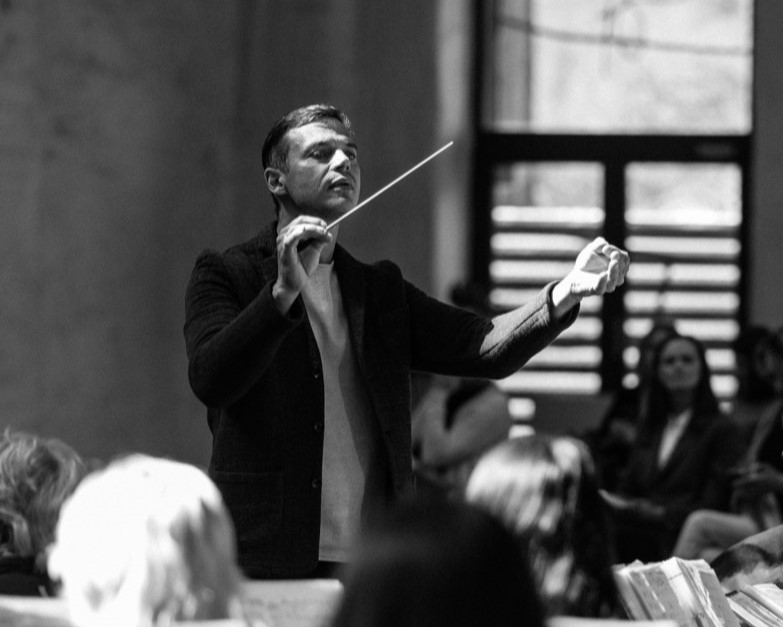
Donatas Ziegoraitis / Photo by J. Suslavičiūtė
My father, the conductor Antanas Ziegoraitis, used to say that sound should be alive - that it carries certain information, that it is not mechanical, that it evolves, that it has a flow of some kind.
What is sound?
It is the vibration we hear. There is order in sound - each frequency sends out its own vibrations. Sound is energy. The energy generated by a symphony orchestra is not great in a physical sense, but you could light a light bulb. But what psychological, emotional energy is there! It is not yet quantified and calculated today, but it is there and we feel it.
If we were immersed in total silence, it would be unbearable. We accept this background, this kind of rustling that we constantly hear in the environment, as a normal state of being. I think that such an active background in a group of people, in a collective, is the healthiest. It indicates a working mood, healthy relationships, sharing of information. While... it doesn't turn into noise, into chaos. Our psyche perceives noise as aggression.Then we react, we get uncomfortable.
Everything in life has its own sound. A touch, a sadness, even the last breath has its own sound. And our emotional intelligence is able to recognise them. We can express joy, pain and wonder through sound - through speech and through music as the highest form of expression of emotion.
When we speak, we convey our emotion through several sounds. In music, we have the ability to play chords. From a single chord, the mood changes - minor or major. We feel it. We use it.
Sometimes the score says: lively. Not cheerful or sad, but lively. Or with passion. Lively and passionately might seem similar, but there is a difference. And we feel those nuances.
What is the difference between happy music and sad music?
There are seven degrees in the range of sounds. Grades 1, 3 and 5 of the gamut (do, mi, sol) are constant, the emotion there is pure, clean. Feeling starts in degrees 2, 4, 6 and 7. In different works we feel this intuitively. These degrees of sound also change as we speak, depending on what we want to say. It is therefore easy to sense when a person is lying: they are sending us the wrong sound signals. Through the degrees of gamut, we hear different information than what is said in words.
The seven degrees of gamut are perceived differently in different cultures. The Arab world hears a lot of things in semitone. The Arabs, to my surprise, have a very clear sense of tone and semitone and, at the same time, they know how to vibrate between them.
We do not hear sounds in the same way, we do not see colours in the same way, because nature rewards people differently. Historical sources have recorded a phenomenon: a man who divided the range of sounds into not 7, but 100 parts and even made an instrument. I was also surprised to learn that people normally see about 5 000 shades of color, while a good artist sees up to 50 000! The question then becomes, can we see what he has painted? Probably not. But we can try to develop this ability. At least in music, you can try to do that.
Excerpt from the seminar "How to Use the Body Intelligence?" organised by Rasa Baltė Balčiūnienė


 Rūdninkų g. 18-203, Vilnius LT-01135
 info@gilu.media