Publications
- Home
- Publications
- Decorator Mantas Petravičius: even Western Europe admires our Lithuanian clay
Decorator Mantas Petravičius: even Western Europe admires our Lithuanian clay
2023 07 03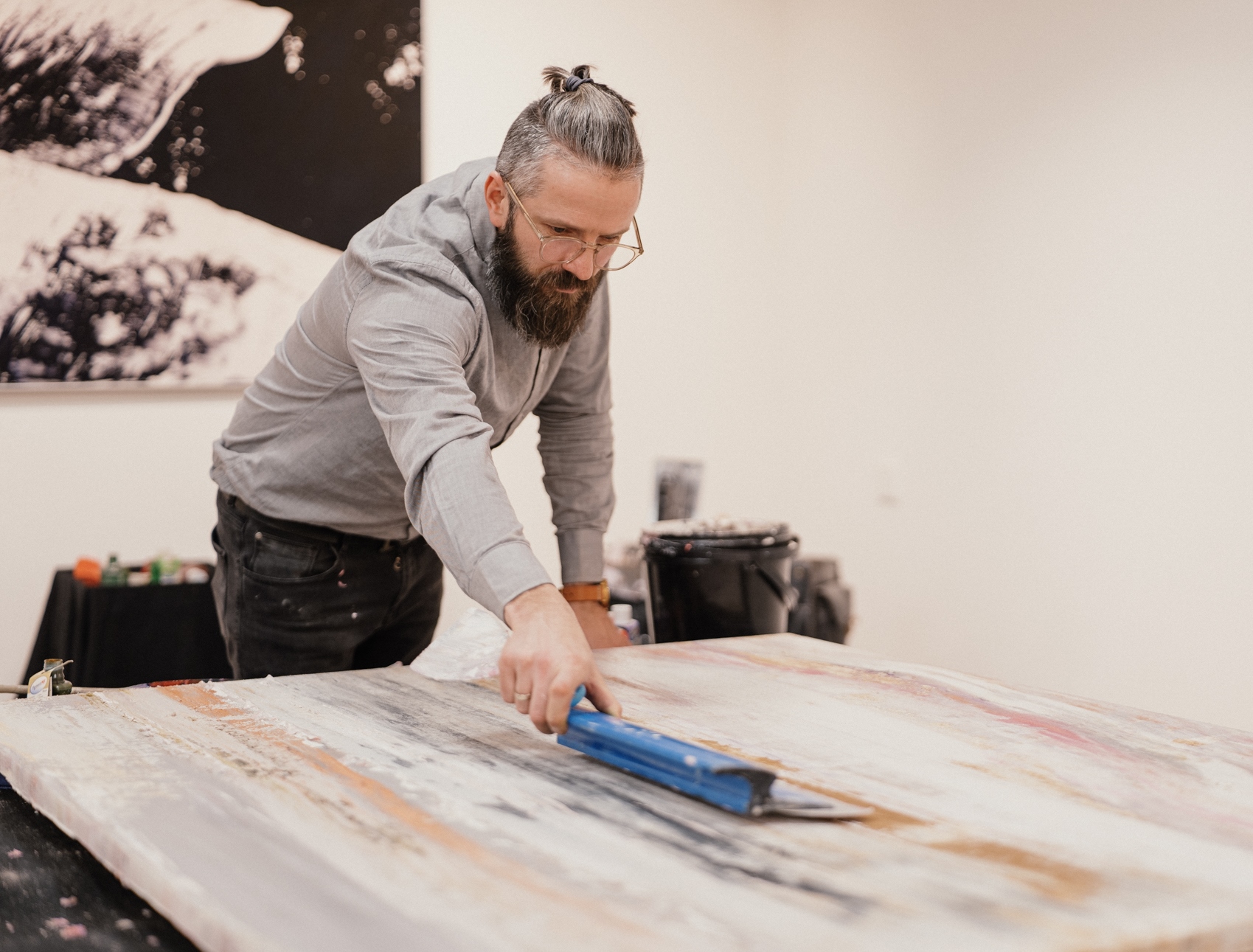
Mantas Petravičius
LRT.lt
Clay and clay plaster in the Lithuanian consciousness until recently, and sometimes even today, are associated with old times, the countryside, deprivation, or people living in a clay hut, who have chosen a radical eco-friendly life. Today, these stereotypes are changing, and decorator, artist Mantas Petravičius, who has been working exclusively with clay plaster since 2015, is making a significant contribution.
- Mantas, how did wall decorating and clay plaster come into your life? How did you become interested in this material?
- It all started when I was studying at the Vilnius Academy of Arts. One of the restorers kept inviting students to help him paint on the walls, which he said he didn't know how to do. So we kept helping him and that was my first experience of painting on walls. Since the Academy of Arts, I got involved in the world of decorating, and it became my source of income at that time. Of course, painting on canvas was much more serious for me and for other students, but over time wall decor took over and now it is my main activity.
Before clay, I had tried a lot of other materials, mostly Italian or Lithuanian, made on the Italian concept. But clay plaster impressed me because it is Lithuanian, because it is our product, created and perfected in Lithuania. Soon after, I met Raimonda Radvilavičienė, who founded the clay plaster brand, and that's how it all began. I started experimenting with what could be done with clay plaster. And you can do a lot of things. So I never let go of this material.
- You also create clay murals and even do it on canvas, right?
- My acquaintance with Rasa Balte Balčiūnienė, the founder of the HAI Institute, led me to experiment with creating clay plaster murals, even though I had only been decorating walls and ceilings before. And Rasa said, "I would like to do a clay plaster on canvas. I started to think about how to do it technically: the canvas, when it gets wet, relaxes and bends. I tried for a long time until I discovered how to do it so that the canvas wouldn't sag - I would put sheets of cardboard underneath and only when the clay was dry would I take them out.
- Clay as a material is still associated in the minds of many Lithuanians from the old days, the countryside, perhaps even deprivation. Or the children of nature who choose to live an ecological life and build a clay hut. How much are you still dealing with these stereotypes and changing them?
- When I first started working, a lot of customers had never heard of clay plaster, they imagined that countryside folks would come and throw clay in their houses... There were a lot of questions about whether it would fall off, whether it would start to mould? But here we were, with a sketch ready to go, a bag of clay plaster, and a completely different working culture. And so, little by little, with this product, we started to break down the old perceptions.
In the past, every house and barn in Lithuania was plastered with clay - it was the easiest, cheapest building material available. However, at some point in time, the thread of clay's development and evolution was cut, and the perception that clay is the favourite material of the Lithuanian countryside, the barn, and the ecologically living oddities remained in people's minds. It was a huge challenge to get over these beliefs.
I remember at the beginning I would come to clients as a specialist who could create wall decor and suddenly I was doing it with clay plaster, which was much better than Italian materials. Everybody was amazed that I was working with Lithuanian clay plaster and that it could look like that.
So little by little, client by client, designer by designer, architect by architect, the perception changed. We have had a lot of interest in this material from colleagues in Europe. The same Italians we used to follow as top masters are now following us. Decorators from other countries are coming, and we are taking them around our facilities. They often say - we are sick of all the glitter, gold, silver decorations. And here we have such a simple, matt, yet very elegant-looking material.
- What is it about clay that fascinates you the most, what makes it special?
- Many people like to touch clay with their hands. For me, this sensation is linked to my childhood, when I used to run barefoot in the countryside on gravel roads and clay paths. Whoever is in contact with the countryside, with nature, that touch is what sticks. Natural materials such as wood, clay, stone, you just want to touch them, it's a pleasure.
In Europe, clay is primarily talked about in terms of its ecological and health-promoting properties. Clay's anti-static properties (dust-free), elasticity, adhesion, anti-mould properties - thirteen points in all - are superior to other building materials. It is a healthy, breathable material that is also pleasant to work with and harmless.
In Lithuania, the most important thing for customers is still that the material is durable and cheap, and only few that ask about its beauty. We tell you about the health benefits already as a gift, as a bonus. In fact, I have noticed that IT professionals ask us to plaster their walls with clay, saying that they want to live in a healthier environment - they already spend a lot of time in front of screens.
- What motivates you the most when working with clay?
- With every new wall, every touch of clay, I want to do something I haven't done before. These new discoveries are what push me forward, even if sometimes the financial benefits are zero. I am well aware that sometimes I stay too long, too focused on one square metre, but that's the only way I make those discoveries, that's how I satisfy my creative curiosity.
Did I think that clay would one day become popular, fashionable? No! I never thought that one day I would set up my own studio. I was just working wall-to-wall. At first it was just one person, then the need for a team came up. The whole creative process has more layers that I can now share with others. I think I have material that I can grow old with, and I believe that my "walk" with clay plaster will not end so soon.
What motivates me, what pushes me forward, is that every year we have one big ambitious artistic project. Last year, we were invited by the famous Austrian artist Ursula Mayer. She called and told us that she was organising an exhibition in Warsaw and needed a special decoration for her walls. We agreed that we would do it. It was only when we got there that we found out that she had been given the biggest space in a contemporary art museum, about 4 000 square metres. We had five days to decorate those walls, and it was a very expensive and complex piece of work. Her idea was to create the spirit of an ancient Tibetan temple and to decorate the walls with ash, clay and water. For four days we sprayed water, ash, clay and - we were done.
And this year, Klaipėda Music Theatre wants to see a clay plaster in its hall. They chose clay plaster because of its excellent acoustic properties. It will also be a complete test of strength. Only during the first concert will we be able to see how the clay plaster "behaves" and "sounds" (laughs).


 Rūdninkų g. 18-203, Vilnius LT-01135
 info@gilu.media